Custom Hydraulic Reservoir Tank Fabrication: What OEMs Need to Know
Most hydraulic system failures don’t start at the pump or the valve. They start at the reservoir.
An undersized tank overheats your fluid. Poor internal baffling introduces air into the system. A leak at a weld seam brings your entire machine down — and a production line with it.
If you’re an OEM manufacturer, equipment designer, or procurement manager sourcing a custom hydraulic reservoir tank, this guide covers what separates a fabricator worth partnering with from one that’s going to cost you time, money, and headaches. We’ll also walk through the key design decisions that affect long-term performance — so you can ask the right questions before you award the work.
For the fundamentals of tank design, sizing, and materials, see our full hydraulic reservoir tank guide.
Why Standard Tanks Often Don’t Cut It for OEM Applications
Off-the-shelf hydraulic reservoir tanks are built for the average application. But most OEM systems aren’t average.
Your machine has a specific envelope. A standard rectangular tank may not fit around your drivetrain components, frame rails, or mounting constraints. Your system may run at higher duty cycles than a generic tank is designed for — which means tighter heat dissipation requirements and heavier gauge steel.
Custom hydraulic reservoir tank fabrication exists precisely because one size doesn’t fit all.
Here’s what a well-designed custom tank delivers that a standard catalog item doesn’t:
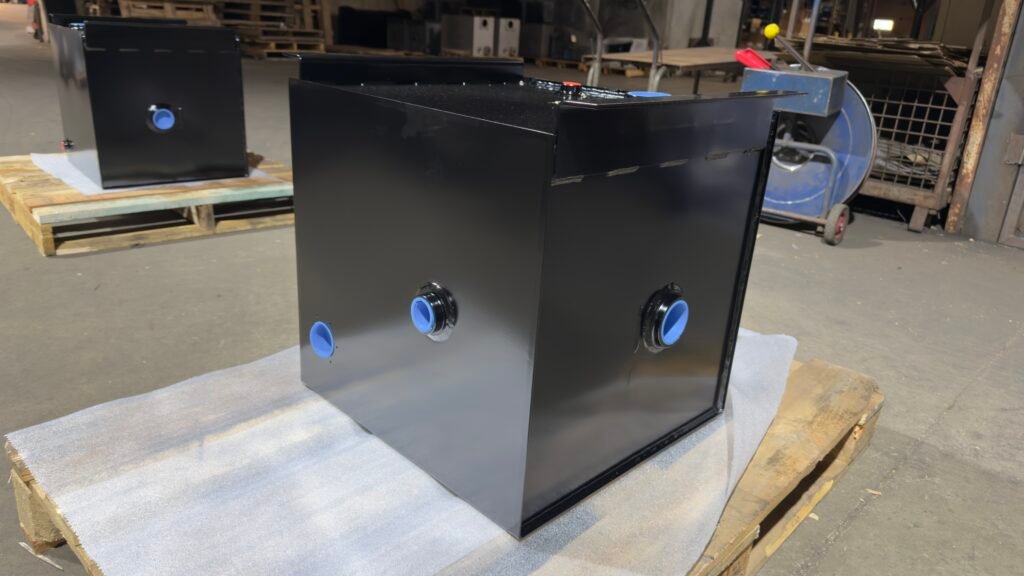
- Exact port placement — suction, return, drain, and auxiliary ports positioned where your plumbing actually runs, not where the catalog says they go
- Custom geometry — L-shaped, wrap-around, saddle-style, or any profile that fits your machine envelope without compromise
- Integrated provisions — bungs, bosses, breather assemblies, and filter mounts welded in at fabrication, not bolted on later
- Heavier gauge steel where it matters — 3/16″ or 1/4″ plate for high-vibration or high-pressure applications, not 12-gauge because it’s cheaper
The difference shows up in service life, assembly time, and field reliability.
What Goes Into a Precision-Welded Hydraulic Reservoir Tank
Understanding how a quality fabricator builds a hydraulic reservoir tank helps you evaluate who you’re sourcing from — and what corners are being cut if the price seems too low.
Steel Selection and Material Certification
Carbon steel is the standard choice for most industrial and mobile hydraulic reservoir tanks. It’s strong, weldable, and cost-effective. Stainless steel makes sense when you’re working with aggressive fluids or corrosive environments. Aluminum appears in weight-sensitive mobile applications.
What separates a serious fabricator from a cut-rate shop is material traceability. Mill certifications should ship with every tank — not as a special request, but as a standard part of the process. If a fabricator hesitates when you ask about material certs, that tells you something.
Internal Baffling and Flow Design
A hydraulic reservoir isn’t just a bucket. The internal design determines how well your fluid separates air, settles contaminants, and dissipates heat before returning to the pump.
Effective baffling routes return flow away from the suction port, giving fluid time to deaerate. Return-line ports should be below the fluid surface to prevent aeration. Suction and return ports should be separated by at least three times the suction pipe’s outside diameter.
These aren’t details a good fabricator skips. They’re the difference between a tank that keeps your system healthy for years and one that quietly degrades your hydraulic fluid quality every hour it runs.
Weld Quality and Leak Testing
Every external seam on a hydraulic reservoir tank is a potential leak point. Robotic welding delivers consistent, repeatable seam quality that manual welding simply can’t match at production volume. For high-vibration applications — construction equipment, ag machinery, mobile hydraulics — weld quality isn’t optional.
After fabrication, every tank should go through air pressure leak testing with a documented hold result. If a fabricator can’t hand you a leak test record with your shipment, you don’t know what you’re receiving.
This has become a non-negotiable for most Tier 1 OEM suppliers. Fabricators that can’t provide documentation are getting dropped from vendor lists — not just for aerospace customers, but across agricultural, construction, and industrial OEM segments.
Key Design Decisions That Affect Long-Term Performance
When you engage a fabricator for custom hydraulic reservoir tank work, these are the design decisions worth getting right upfront.
Sizing: More Than Just Gallons
The common rule of thumb — size your reservoir at 2–3× your pump’s GPM flow rate — is a starting point, not a final answer. High duty cycle systems, applications with significant heat loads, and systems running high-viscosity fluid all require larger reservoirs to maintain acceptable operating temperatures.
Get your fabricator involved in the sizing conversation early. A shop that only cuts and welds to your print is less valuable than one that can flag a sizing issue before it becomes a field problem.
Mounting and Integration
How the tank mounts to your machine matters as much as its internal design. Mounting flanges, foot pads, and gusset locations should be designed for the actual load path — not wherever was convenient to weld.
Custom saddle-style and wrap-around tanks that integrate with frame rails or chassis members require fabricators with strong engineering collaboration capability. This is where working with a shop that engages at the design stage — not after the drawing is released — pays for itself.
Surface Finish and Corrosion Protection
For outdoor and mobile applications, external corrosion protection extends service life significantly. Primer and topcoat painting is standard. Some applications benefit from powder coat or specialized coatings for particularly harsh environments.
Specify your finish requirements upfront. A fabricator handling painting in-house — rather than subcontracting it — reduces handoffs, lead time, and quality risk.
What to Look for in a Custom Hydraulic Reservoir Tank Fabricator
The fabrication market has consolidated around capability. OEMs are increasingly sourcing from shops that can take raw steel through laser cutting, forming, welding, leak testing, and painting under one roof — rather than managing four vendors for a single assembly.
Here are the questions that matter when you’re evaluating a hydraulic tank fabricator:
What’s your in-house capability scope? Can they take raw material through to a finished, tested, painted assembly? Or do they subcontract forming or painting — adding lead time, cost, and quality risk at every handoff?
What does your weld process look like? Robotic welding for production runs, manual welding for complex or one-off geometries. A shop with both capabilities handles more of your work without compromises.
What documentation ships with each tank? Material certs, dimensional inspection records, weld procedure documentation, and leak test results should be standard, not special requests.
What are your lead times for prototypes vs. production runs? For most capable domestic shops, prototypes run 1–2 weeks. Production quantities typically run 3–6 weeks. If a fabricator is quoting significantly longer without a clear explanation, ask why.
Can you support engineering collaboration during design? The fabricators that deliver the best long-term results engage during concept and detail design — not after the drawing is released. Early input on geometry, weld joint count, and material gauge can reduce fabrication cost by 15–25% compared to a design that wasn’t optimized for manufacturability.
Why Domestic Fabrication Is Back on the Table
The shift toward U.S.-based custom hydraulic reservoir tank fabrication isn’t a passing trend. It’s structural.
Tariff uncertainty and overseas lead time variability have made offshore sourcing significantly harder to manage for anything requiring close tolerances, engineering collaboration, or fast prototype turnaround. For OEMs running lean production schedules, a tank that arrives two weeks late isn’t a minor inconvenience — it shuts down an assembly line.
Domestic fabricators who can provide short, reliable lead times, engineering collaboration, and full quality documentation are qualifying for OEM vendor lists that overseas suppliers are being dropped from — regardless of unit price differences.
The math has changed. Total cost of ownership — including rework, expediting, and schedule risk — often favors domestic sourcing for complex fabricated assemblies like hydraulic reservoir tanks.
Frequently Asked Questions
Start with 2–3× your pump’s GPM flow rate as a baseline, then adjust upward for high duty cycles, high ambient temperatures, or heat-intensive applications. Engage your fabricator during sizing — a good shop will flag concerns before fabrication, not after.
For most industrial and mobile applications, 3/16″ or 1/4″ plate balances strength, weldability, and weight. High-vibration environments and continuous-duty systems trend toward heavier gauge for longer service life. 12-gauge may be acceptable for light-duty or low-pressure applications, but verify with your fabricator.
At minimum: material mill certifications, air pressure leak test records with documented hold results, and weld inspection documentation. Dimensional inspection reports are increasingly standard for OEM customers. If a fabricator can’t provide these as a standard deliverable, qualify another supplier.
Prototypes typically run 1–2 weeks at a well-organized domestic shop. Production quantities run 3–6 weeks depending on complexity and shop utilization. Engage your fabricator early if you have a hard schedule date — especially for complex geometries or large OEM production runs.
The best fabricators prefer to engage during design. Early collaboration on geometry, port placement, mounting provisions, and weld joint design reduces cost and improves the final product. If you have a concept but not a finished drawing, bring it to a capable shop before you release it for fabrication.
Look for a fabricator — not a catalog distributor — that builds to your drawing or spec, works in both carbon and stainless steel, and handles everything from one-off tanks to production runs. Engineered Welding, Inc. in Anamosa, Iowa fabricates custom hydraulic reservoir tanks for OEMs across the Midwest and nationwide, quoting directly from CAD files, prints, or dimensioned sketches.
Catalog suppliers sell standard sizes; when your machine needs specific dimensions, port locations, baffle placement, or mounting, a custom fabricator builds the tank to your exact spec. Engineered Welding builds custom-size steel and stainless steel reservoirs — send your dimensions or a drawing for a quote.
The US market splits into two groups: catalog manufacturers producing standard off-the-shelf reservoirs, and custom fabricators building tanks to spec. If a standard size fits your system, catalog brands serve that well. If you need custom dimensions, specific port and baffle configurations, stainless construction, or OEM production volumes with consistent quality, a certified custom fabricator like Engineered Welding, Inc. is the better fit.
Yes — a 50-gallon reservoir is a common custom build. Send the envelope dimensions (or let us propose them), material, port sizes and locations, and any baffle or accessory requirements, and you’ll get a firm quote. A dimensioned sketch is enough to start; you don’t need a finished CAD model.
Ready to Source Your Next Custom Hydraulic Reservoir Tank?
Engineered Welding has been building precision-welded hydraulic reservoir tanks for OEM manufacturers, agricultural equipment builders, and industrial customers since 2002. We work in carbon steel, stainless, and aluminum — with full in-house capability from laser cutting through leak testing and painting.
If you have a drawing, we’ll quote it fast. If you’re still in design, we’re the kind of shop that wants to be involved early.