
If you’ve ever wondered how a 40-ton excavator lifts a boulder without breaking a sweat, the answer is a hydraulic system. These systems use pressurized fluid instead of gears or belts to move heavy loads with precision, and you’ll find them running construction equipment, farm machinery, factory presses, and just about anything else that needs serious force in a small package.
This guide walks through how a hydraulic system actually works, the components that make it up, how to size one, and what it takes to keep it running for years instead of months. We’ll also cover the hydraulic reservoir tank in more depth than most guides bother to, since it’s the part most people underestimate until it fails.
How Does a Hydraulic System Work?
Here’s the short version: fluid sits in the reservoir tank, the pump pulls it in and pressurizes it, valves direct that pressurized fluid to the right place, and a cylinder or motor converts it into mechanical motion. Once the job is done, the fluid returns through a filter and back into the reservoir to start the loop again.
The physics behind all of this is Pascal’s Law, which says that pressure applied to a confined fluid transmits equally in all directions. In practice, that means a small amount of force on a small piston can generate a much larger force on a bigger piston, as long as the pressure stays constant. That’s why a hydraulic jack the size of a shoebox can lift a car.
Three things determine how a system performs: the pressure the pump can generate, the flow rate it delivers, and how well the fluid is kept clean and cool along the way. Get any of those wrong and you’ll see it in the machine’s performance before you see it on paper.
The Main Components of a Hydraulic System
Every hydraulic system, no matter how complex, comes down to a handful of core parts working together.
- Hydraulic reservoir tank – Stores the fluid, sheds heat, and gives contaminants and air bubbles somewhere to settle out before the fluid gets pulled back into the pump.
- Hydraulic pump – Converts mechanical energy (usually from an electric motor or engine) into hydraulic energy by pressurizing the fluid.
- Valves – Direct, regulate, and control the flow and pressure of the fluid, from simple relief valves to complex proportional and servo valves.
- Cylinders and motors – Convert hydraulic energy back into mechanical work, either as linear motion (cylinders) or rotary motion (motors).
- Hoses and fittings – Carry pressurized fluid between components and need to be rated for the system’s working pressure, not just its average pressure.
- Filters – Remove particulate contamination that would otherwise score pumps, valves, and cylinder seals.
- Hydraulic fluid – The medium that actually transmits power, chosen for viscosity, additive package, and compatibility with seals and components.
Miss or skimp on any one of these, and the whole system pays for it. A cheap filter, for example, can quietly wear out a $15,000 pump over a couple of years.
Why the Hydraulic Reservoir Tank Deserves More Attention Than It Gets
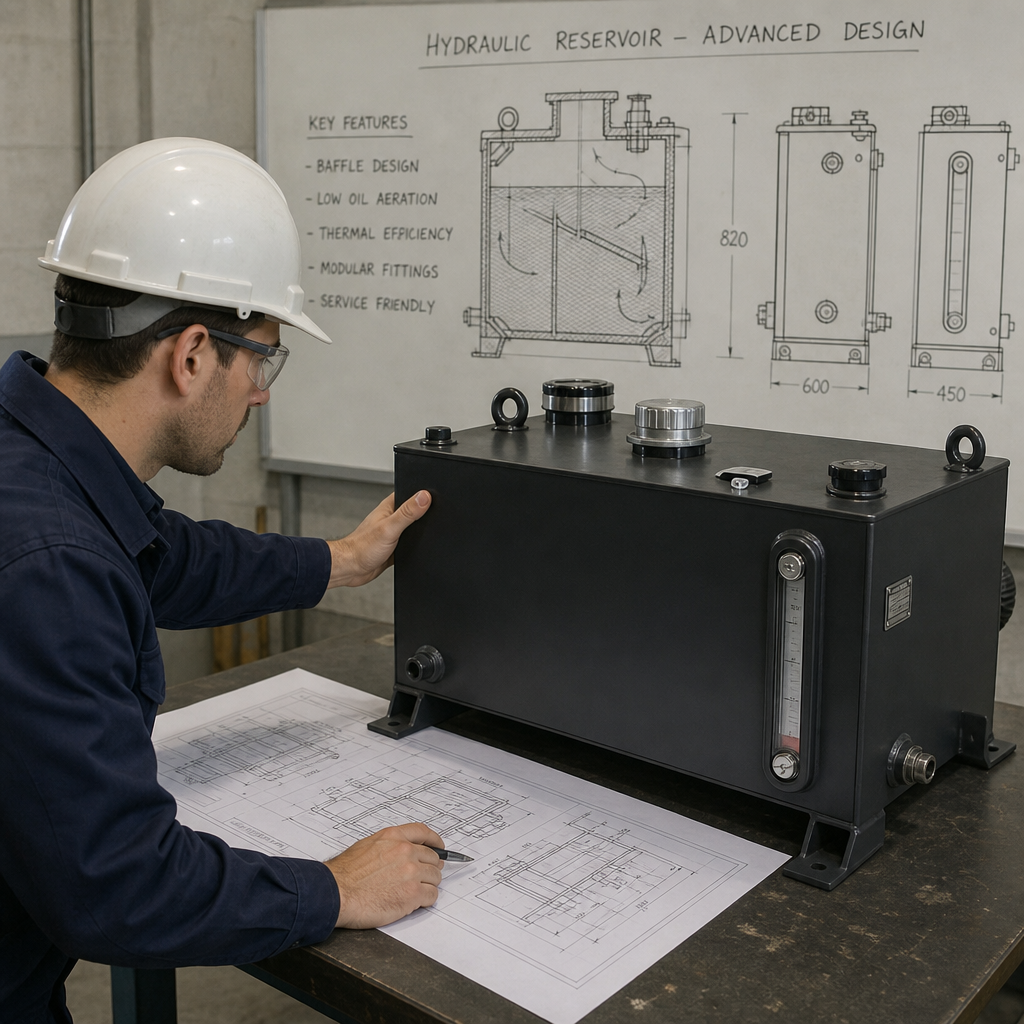
Most people treat the reservoir as a glorified bucket. It’s not. A well-designed hydraulic reservoir tank does four jobs at once: it stores fluid, dissipates heat, releases entrained air, and lets contaminants settle before they reach the pump inlet.
Good tank designs share a few features: internal baffles that slow the fluid down and separate suction from return flow, properly spaced suction and return ports so hot return oil doesn’t get pulled straight back into the pump, clean-out covers for servicing, breather filters that keep airborne dirt out, and a sight gauge plus temperature monitoring so problems show up before they become failures.
Here’s where a lot of equipment builders run into trouble: standard, off-the-shelf reservoirs are designed for average use cases, not your specific machine. If your OEM packaging is tight, your port locations don’t match a catalog tank, or you need integrated mounting brackets, a standard reservoir either won’t fit or will force compromises elsewhere in the design. That’s when a custom-fabricated hydraulic reservoir tank, built and leak-tested to your exact drawing, earns its keep.
Hydraulic Power Units: The All-in-One Package
A hydraulic power unit (HPU) bundles the reservoir, pump, motor, valves, filtration, and instrumentation into a single, self-contained package. Instead of specifying and mounting each component separately, you get one unit that’s already been engineered to work together.
The tradeoff is that an HPU is only as good as its weakest design decision. Cooling capacity, filtration quality, and service access all matter just as much in a packaged unit as they do in a system you build piece by piece. A compact HPU that traps heat or makes filter changes a two-hour ordeal will cost you more in downtime than it saved in footprint.
Open-Loop vs. Closed-Loop Hydraulic Systems
Not every hydraulic system routes fluid the same way, and the difference matters when you’re troubleshooting or designing one.
Open-loop systems send return oil back to the reservoir before it’s picked up again by the pump. This is the setup you’ll see in most cylinder-driven equipment and general industrial machinery, since it’s simpler and easier to service.
Closed-loop systems return oil directly from the motor back to the pump inlet, skipping the reservoir in the main loop. You’ll find these in hydrostatic drives, like the ones that power the tracks on a skid steer, where quick response and smooth reversing matter more than simplicity.
Sizing a Hydraulic System: The Formulas That Matter
Sizing mistakes are one of the most common (and expensive) errors in hydraulic design. Three formulas cover most of what you need:
- Force = Pressure × Area
- Flow = Area × Speed
- Hydraulic Horsepower ≈ (PSI × GPM) / 1714
Here’s a quick example: say a cylinder needs to move a 10,000-pound load and has a 4-square-inch piston area. That means you need at least 2,500 PSI (10,000 ÷ 4) just to move the load, before accounting for friction, seal drag, or a safety margin. If that cylinder needs to extend at 10 GPM, your pump needs to deliver both that pressure and that flow simultaneously, which works out to roughly 14.6 hydraulic horsepower (2,500 × 10 ÷ 1714).
Always verify these numbers against the duty cycle, expected heat load, and the manufacturer’s own specifications. A system that’s sized correctly on paper can still overheat if it’s run at full load for hours at a stretch without enough cooling capacity.
Routine Maintenance That Prevents Costly Downtime
Most hydraulic failures don’t happen suddenly. They build up over weeks or months of small, ignored warning signs. A basic maintenance routine catches them early:
- Check fluid levels regularly and top off with the correct fluid, not whatever’s on the shelf.
- Replace filters on schedule, not just when a gauge finally flags a problem.
- Monitor oil cleanliness with periodic oil analysis rather than relying on visual inspection alone.
- Inspect hoses and fittings for wear, abrasion, and soft spots before they become leaks.
- Watch operating temperature, since consistently hot fluid breaks down faster and damages seals.
None of this is complicated, but it does require consistency. A quarterly oil analysis costs a fraction of what a scored pump does.
Troubleshooting Common Hydraulic Problems
Overheating
Usually caused by a clogged cooler, low fluid level, or the wrong viscosity oil for the operating temperature. Check the cooler first, since it’s the most common culprit.
Slow or Sluggish Movement
This often points to pump wear reducing output, a clogged filter restricting flow, or a partially closed valve. Pressure and flow testing will usually isolate which one.
Unusual Noise
A whining or knocking sound is a classic sign of cavitation or air ingress, usually caused by a restricted suction line or a reservoir level that’s dropped too low.
Cylinder Drift
If a cylinder slowly loses position under load, suspect worn piston seals or a leaking directional valve. Neither improves on its own, so plan on a repair rather than a workaround.
How to Bleed Air Out of a Hydraulic System
Air trapped in the lines shows up as spongy or erratic movement. Loosen the bleed screws or highest-point fittings, run the system at low pressure until steady fluid (no bubbles) flows out, then retighten. Always check the fluid level afterward, since bleeding uses up reservoir volume.
Standard vs. Custom Hydraulic Reservoir Tanks: Which Do You Need?
A standard, catalog reservoir works fine when your equipment has generous space, standard port locations, and no unusual mounting requirements. But choose a custom hydraulic reservoir when:
- Equipment space is tight and a stock tank simply won’t fit.
- You need port locations that don’t match any catalog product.
- Integrated mounting brackets or structural strength requirements are part of the spec.
- You’re replacing a discontinued or hard-to-source OEM tank.
Quality matters as much as fit. A custom tank is only as good as its welds, and a reservoir that leaks under pressure or vibration defeats the purpose of building one in the first place. Leak-tested, fully welded assemblies, built from your CAD drawing rather than a generic template, are what separate a tank that lasts a decade from one that needs rework in year two.
Conclusion
A reliable hydraulic system comes down to a handful of fundamentals: correct sizing, clean fluid, quality components, and maintenance that actually happens on schedule. The hydraulic reservoir tank sits at the center of all of it, handling cooling, deaeration, and contamination control every time the system runs.
If your equipment needs a reservoir tank that a catalog can’t provide, request a quote with your CAD drawing and operating requirements, and we’ll help you get it right the first time.
Frequently Asked Questions
What is a hydraulic system?
A hydraulic system uses pressurized fluid to transmit power and perform mechanical work, commonly for lifting, pushing, or driving heavy equipment.
How does a hydraulic system work?
Fluid is drawn from the reservoir, pressurized by the pump, directed through valves, and used to move a cylinder or motor. Return fluid is filtered and sent back to the reservoir.
What are the five basic components of a hydraulic system?
The reservoir, pump, valves, actuator (cylinder or motor), and hydraulic fluid.
What does a hydraulic reservoir tank do?
It stores, cools, and conditions the hydraulic fluid while supporting the pump and separating air and contaminants from the system.
What causes hydraulic overheating?
Poor cooling, incorrect fluid viscosity, clogged filters, excessive system pressure, or a failing relief valve.
What is cavitation?
The formation and collapse of vapor bubbles caused by insufficient fluid at the pump inlet, usually from a restricted suction line or low reservoir level.
How do I bleed air out of a hydraulic system?
Open the bleed screws or highest-point fittings and run the system at low pressure until fluid flows without bubbles, then check the fluid level.
How often should hydraulic fluid be changed?
Follow the equipment manufacturer’s recommendation, and confirm the interval with periodic oil analysis rather than a fixed calendar date alone.
Why is filtration important in a hydraulic system?
Clean fluid reduces wear on pumps, valves, and seals, which extends component life and reduces unplanned downtime.
What is a hydraulic power unit?
A complete, packaged assembly combining the pump, motor, reservoir, filters, and controls into one unit.
What’s the difference between open-loop and closed-loop hydraulics?
Open-loop systems return fluid to the reservoir before recirculation; closed-loop systems return fluid directly to the pump, common in hydrostatic drives.
When should I use a custom hydraulic reservoir tank?
When a standard tank can’t meet your packaging, port location, mounting, or capacity requirements.
Why are baffles important in a reservoir tank?
They slow fluid movement, separate suction from return flow, and improve both cooling and air separation.
How can I request a custom hydraulic reservoir tank?
Prepare your CAD drawing and operating requirements, then request a quote so it can be built and leak-tested to spec.