Custom Hydraulic Reservoir Tanks for OEM Equipment
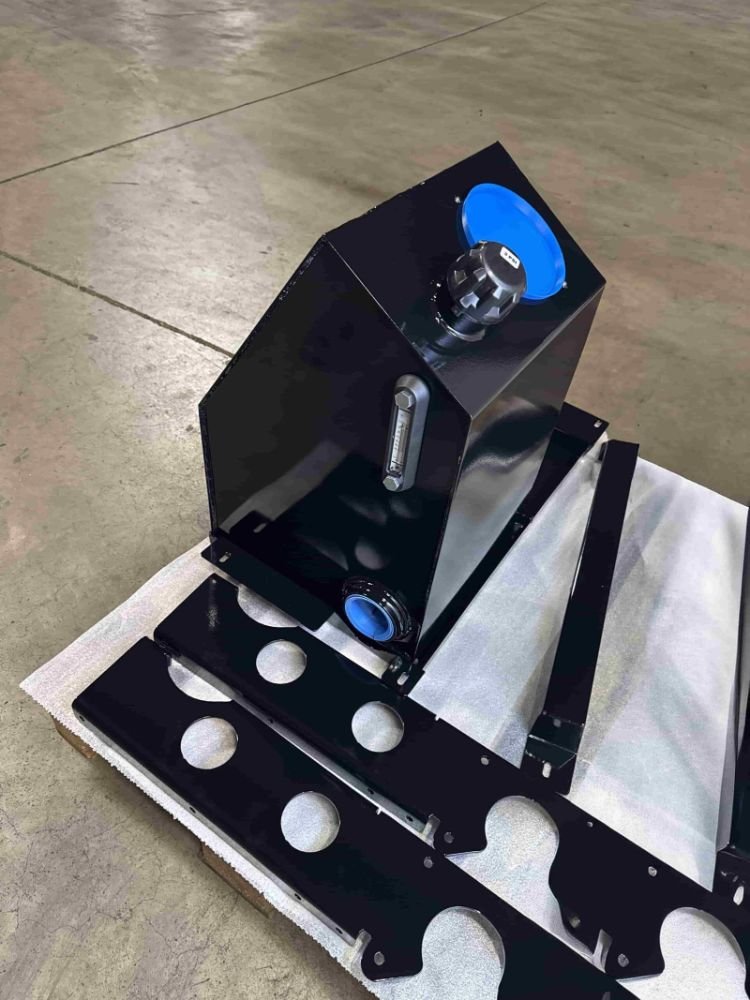
Engineered Welding designs and manufactures custom hydraulic reservoir tanks for OEM equipment builders, hydraulic power units, agricultural machinery, construction equipment, and industrial systems. Every reservoir is built in our Iowa facility using HD plasma cutting, CNC press brake forming, robotic and manual welding, leak testing, and in-house powder coating.
What Is a Hydraulic Reservoir Tank?
A hydraulic reservoir tank — sometimes called a hydraulic oil tank or oil reservoir — is the component of a hydraulic system that stores hydraulic fluid and conditions it before sending it back to the pump. It looks like a simple box, but a well-designed hydraulic fluid reservoir is doing several jobs at once, every second the system runs.
- Stores hydraulic fluid — holds the volume of oil needed to keep the pump supplied, plus reserve capacity for when cylinders extend.
- Removes heat — the tank’s surface area radiates heat out of the fluid and into the surrounding air.
- Removes air — gives entrained air bubbles time to rise to the surface and escape before fluid reaches the pump.
- Removes contaminants — slows fluid velocity so dirt, metal fines, and debris can settle out instead of recirculating.
- Supplies oil to the pump — delivers clean, de-aerated, temperature-stable fluid to the suction line on demand.
How Does a Hydraulic Reservoir Tank Work?
Every hydraulic reservoir works on the same basic cycle, whether it’s a 10-gallon unit on a skid steer or a 150-gallon tank on a stationary power unit.
- Oil return — fluid coming back from cylinders and valves enters the tank through the return port.
- Cooling — heat picked up in the system transfers from the fluid into the tank walls and surrounding air.
- Baffles — internal plates slow the fluid, separate the return side from the suction side, and calm turbulence.
- Air separation — the reduced velocity behind the baffle gives entrained air time to rise out of the fluid.
- Pump suction — cooled, de-aerated fluid is drawn from the suction side back into the pump to complete the cycle.
Types of Hydraulic Reservoir Tanks
Not every hydraulic reservoir tank looks or performs the same. The right type depends on the equipment, the fluid, and the space available.
Welded Steel
The most common construction for industrial and OEM hydraulic tanks — strong, weldable, and economical for high-volume production.
Stainless Steel
Used where corrosion resistance matters: washdown environments, food-grade equipment, marine applications, and chemical exposure.
Aluminum
Lightweight construction for mobile and aerial equipment where every pound affects payload or lift capacity.
Vertical Reservoirs
Smaller footprint, ideal for stationary hydraulic power units where floor space is limited but height is available.
Horizontal Reservoirs
More fluid surface area relative to height, improving heat dissipation and air separation — common on mobile equipment.
Mobile Equipment Tanks
Built to handle vibration, tilt, and temperature swings on tractors, trucks, and off-road machinery.
Hydraulic Power Unit Reservoirs
Sized and configured to match a specific pump, motor, and valve package for a self-contained HPU.
Why Choose a Custom Hydraulic Reservoir Tank?
Stock reservoirs are built to fit as many machines as possible — which usually means they fit none of them particularly well. A custom hydraulic reservoir tank is built around your equipment’s actual constraints, not a generic footprint.
- Exact dimensions for your equipment envelope
- Improved space utilization on tight chassis layouts
- Better cooling through a surface area matched to your heat load
- Easier maintenance with ports and covers placed where technicians can reach them
- OEM branding and finish options
- Custom port locations and sizes
- Mounting brackets built to your frame, not adapted after the fact
- Sensor and gauge locations positioned for your control system
- Higher reliability from a tank engineered for its actual duty cycle
Custom Manufacturer vs. Catalog Supplier
Here’s how a custom-built hydraulic reservoir tank generally compares to an off-the-shelf catalog unit:
| Feature | Engineered Welding (Custom) | Typical Catalog Supplier |
|---|---|---|
| Custom size & port layout | Yes | No |
| CAD design support | Yes | No |
| Leak tested before shipment | Every unit | Varies by supplier |
| Powder coated finish | Yes, in-house | Sometimes, as an add-on |
| Prototype quantities | Yes | Usually not |
| Production quantities | Yes | Limited by stock SKUs |
| Made in USA | Yes — Anamosa, Iowa | Varies |
General industry comparison for planning purposes — always confirm capabilities directly with any supplier you’re evaluating.
CUSTOM HYDRAULIC RESERVOIR TANK DESIGN
Every custom hydraulic reservoir tank we build starts with your CAD file or spec sheet. The core design decisions include:
- Tank dimensions
- Capacity
- Wall thickness
- Mounting configuration
- Port locations & sizes
- Internal baffles
- Clean-out cover
- Drain
- Sight gauge
- Filler breather
Wall thickness and mounting need to account for the weight of the fluid when full, plus vibration and shock loads on mobile equipment. We build to your drawing’s exact dimensions and port callouts rather than adapting a stock tank.
Hydraulic Reservoir Tank Sizing Guide
A common starting point for reservoir sizing is matching tank capacity to pump flow rate:
| Pump Flow | Example Tank Capacity |
|---|---|
| 5 GPM | 10 Gallons |
| 10 GPM | 20 Gallons |
| 25 GPM | 40 Gallons |
| 50 GPM | 75 Gallons |
Hydraulic reservoir sizing depends on pump flow, duty cycle, heat generation, operating temperature, fluid volume changes, available cooling, and the hydraulic circuit design. The capacities above are illustrative examples, not universal recommendations. Final reservoir dimensions and usable fluid capacity should be verified against the equipment’s operating requirements. For additional guidance, see our hydraulic reservoir tank sizing guide.
Steel, Stainless Steel & Aluminum Hydraulic Reservoir Tanks
Engineered Welding, Inc. manufactures custom hydraulic reservoir tanks in carbon steel, stainless steel, and aluminum for OEM equipment and industrial applications. Material selection depends on corrosion exposure, operating conditions, weight requirements, and customer specifications.
Carbon Steel Hydraulic Reservoir Tanks
Custom welded steel hydraulic tanks for agricultural machinery, construction equipment, hydraulic power units, and industrial systems.
- Strong, durable welded construction
- Economical for production quantities
- Custom wall thicknesses and baffles
- Custom mounting brackets and ports
- In-house powder coating available
Stainless Steel Hydraulic Reservoir Tanks
Custom stainless steel reservoirs for applications requiring corrosion resistance, including washdown, marine, and demanding industrial environments.
- Corrosion-resistant welded construction
- Material grades selected for the application
- Custom suction and return connections
- Drain and inspection port options
- Built to customer drawings
Aluminum Hydraulic Reservoir Tanks
Custom aluminum hydraulic reservoirs for OEM equipment where reduced weight is important, including mobile and weight-sensitive applications.
- Lightweight construction
- Good corrosion resistance in suitable environments
- Custom tank dimensions
- Welded construction to specifications
- Custom mounting and port configurations
Need a custom reservoir? Send us your CAD drawings, material requirements, and estimated quantity. Request a hydraulic reservoir tank quote .
HOW WE MANUFACTURE CUSTOM HYDRAULIC RESERVOIR TANKS
Engineered Welding, Inc. is a custom hydraulic reservoir tank manufacturer based in Anamosa, Iowa, serving OEM equipment builders and industrial customers. Our manufacturing process includes CAD drawing review, HD plasma cutting, CNC press brake forming, robotic and manual welding, leak testing, and in-house powder coating. We manufacture carbon steel, stainless steel, and aluminum hydraulic reservoir tanks to customer specifications, supporting both prototype development and production orders.
1. CAD Design & Drawing Review
Engineered Welding accepts STEP, DXF, SolidWorks, and PDF drawings for custom hydraulic reservoir manufacturing. Our team reviews tank dimensions, material specifications, wall thickness, port locations, mounting requirements, and weld details before fabrication. We support prototype development and repeat production based on customer drawings.
2. HD Plasma Cutting
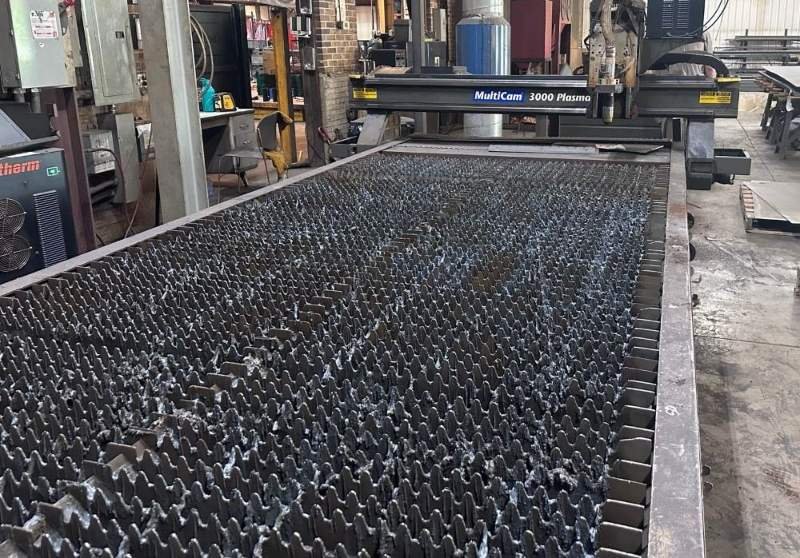
Our MultiCam HD plasma cutting system produces profiles for steel, stainless steel, and aluminum hydraulic reservoir components. CNC-controlled cutting supports consistent part geometry for prototype and production manufacturing.
- Custom tank panels and component profiles
- CNC-controlled cutting from approved drawings
- Repeatable production of formed and welded components
- Cutting parameters selected for material and thickness
3. CNC Press Brake Forming
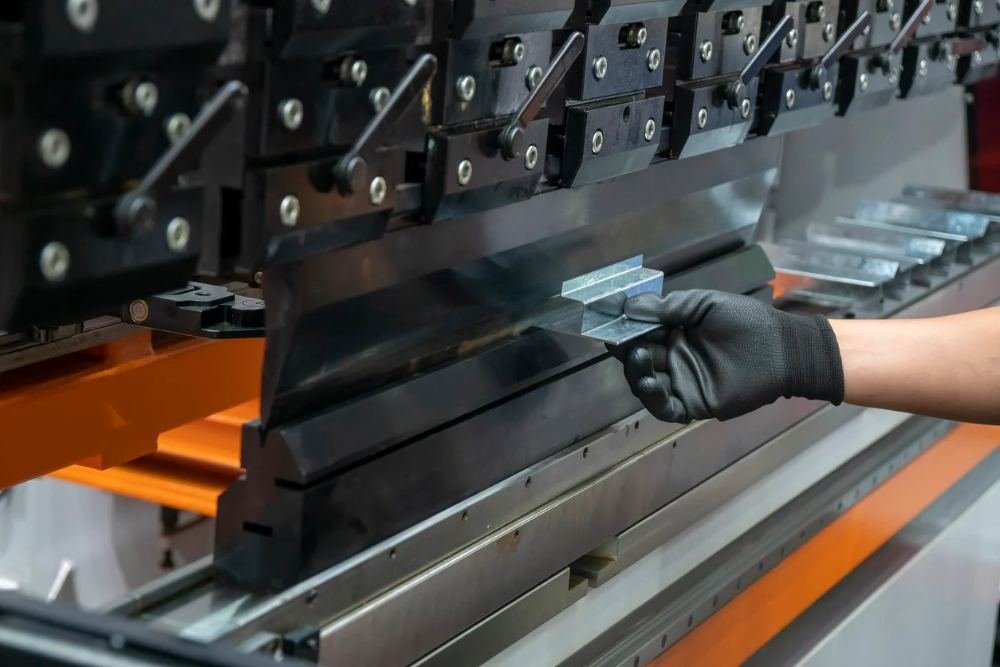
Engineered Welding uses CNC press brake forming to produce hydraulic reservoir tank panels, brackets, and formed components from carbon steel, stainless steel, and aluminum. CNC-controlled bending supports consistent part dimensions and repeatable manufacturing for custom OEM reservoir assemblies.
- Custom hydraulic tank wall and panel forming
- Carbon steel, stainless steel, and aluminum
- Repeatable bends for production quantities
- Forming based on customer drawings and specifications
4. Robotic MIG Welding
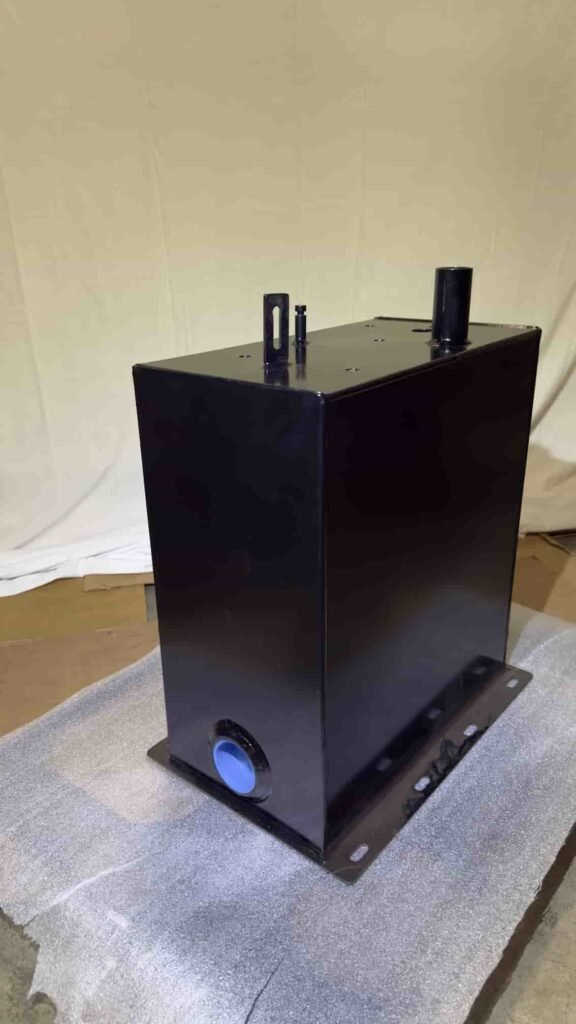
Engineered Welding uses robotic MIG welding for repeat production of hydraulic reservoir tanks and welded components. Our robotic welding cells support consistent weld placement and repeatable production processes for OEM manufacturing programs.
- Robotic MIG welding for repeat production
- Consistent weld placement on suitable assemblies
- Production welding of reservoir components
- Manual welding available for complex configurations
5. Manual MIG & TIG Welding
Engineered Welding provides manual MIG and TIG welding for custom hydraulic reservoir tanks, prototypes, and complex welded assemblies. Our welding capabilities support carbon steel, stainless steel, and aluminum reservoir fabrication, including custom port connections, mounting brackets, internal baffles, and tank seams. Welding methods and inspection requirements are reviewed according to customer specifications.
6. Leak Testing & Quality Inspection
Engineered Welding performs leak testing and final inspection on hydraulic reservoir tanks before shipment. Our inspection process includes checking welded seams, tank dimensions, port locations, fittings, and overall workmanship against customer requirements.
- Leak testing of completed reservoir tanks
- Visual inspection of welded assemblies
- Dimensional and port-location verification
- Internal cleanliness inspection for metal chips, weld spatter, slag, and fabrication debris
- Inspection documentation available as agreed with the customer
We’ve built over 80,000 hydraulic reservoirs with zero defects — leak testing every unit before it leaves our shop is the reason why.
7. In-House Powder Coating & Finishing
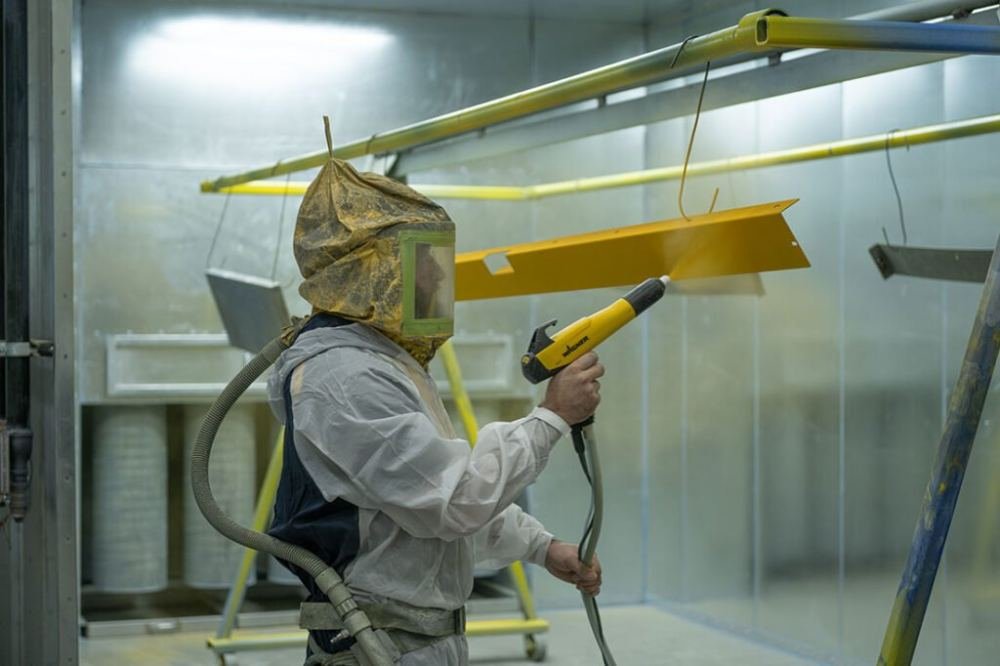
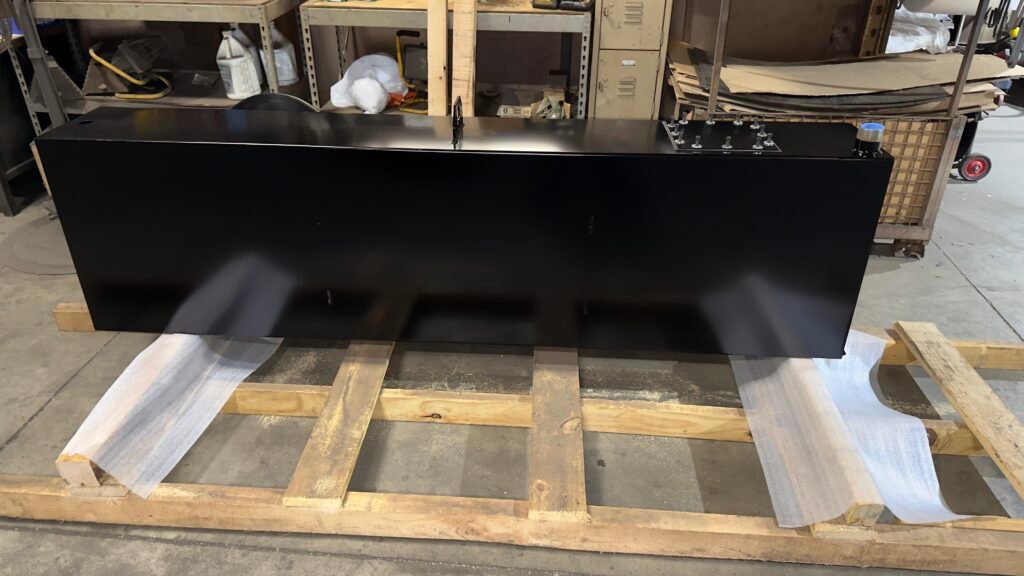
Engineered Welding offers in-house powder coating for custom hydraulic reservoir tanks and fabricated steel components. Surface preparation and coating requirements are selected according to the material, customer specifications, and intended service environment.
- In-house powder coating capability
- Custom colors and finish requirements
- Surface preparation before coating
- Finished tank inspection before shipment
Standard Features
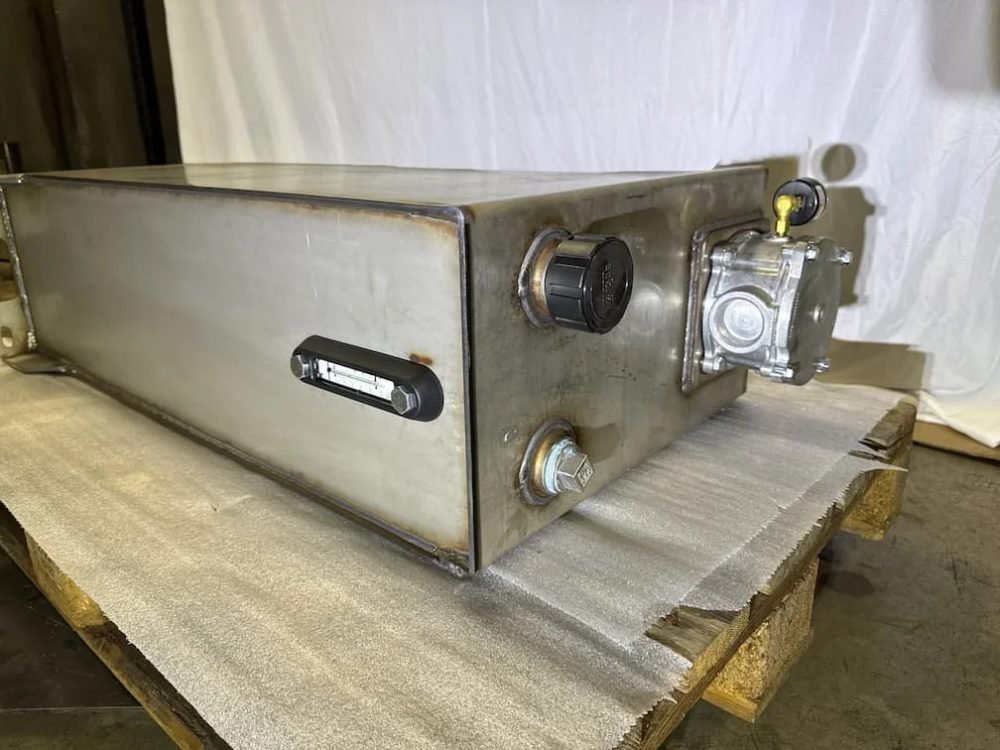
- Internal baffles
- Sight gauge
- Drain plug
- Suction port
- Return port
- Inspection cover
- Magnetic drain
- Mounting brackets
- Filler breather
- Temperature gauge
Recent Hydraulic Reservoir Projects
A look at representative reservoir builds from our Anamosa, Iowa shop.
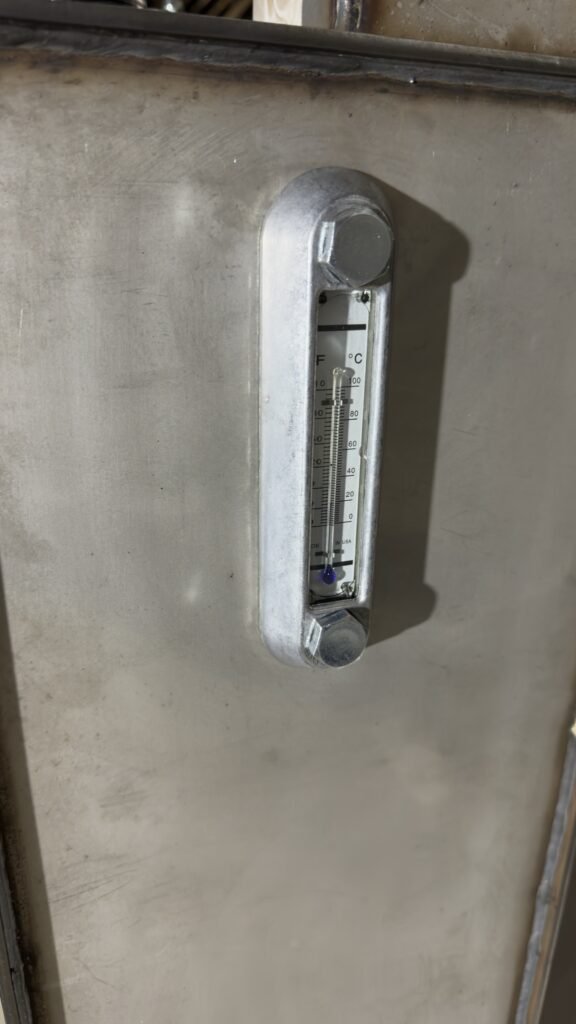 Agricultural & Mobile
Compact Reservoir, Sight Gauge & Temp Indicator
Built for space-constrained mobile equipment where operators need a quick visual fluid check in the field.
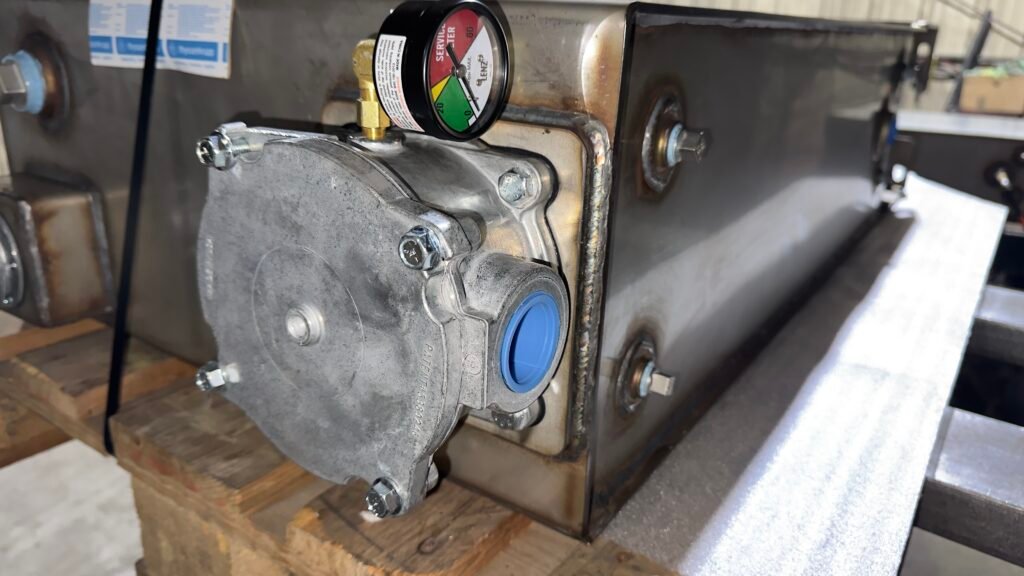 Washdown / Food-Grade
Stainless Reservoir with Integrated Pump Mount
Fabricated in stainless for a washdown-environment application, with pump mount and pressure gauge built in.
Industrial / HPU
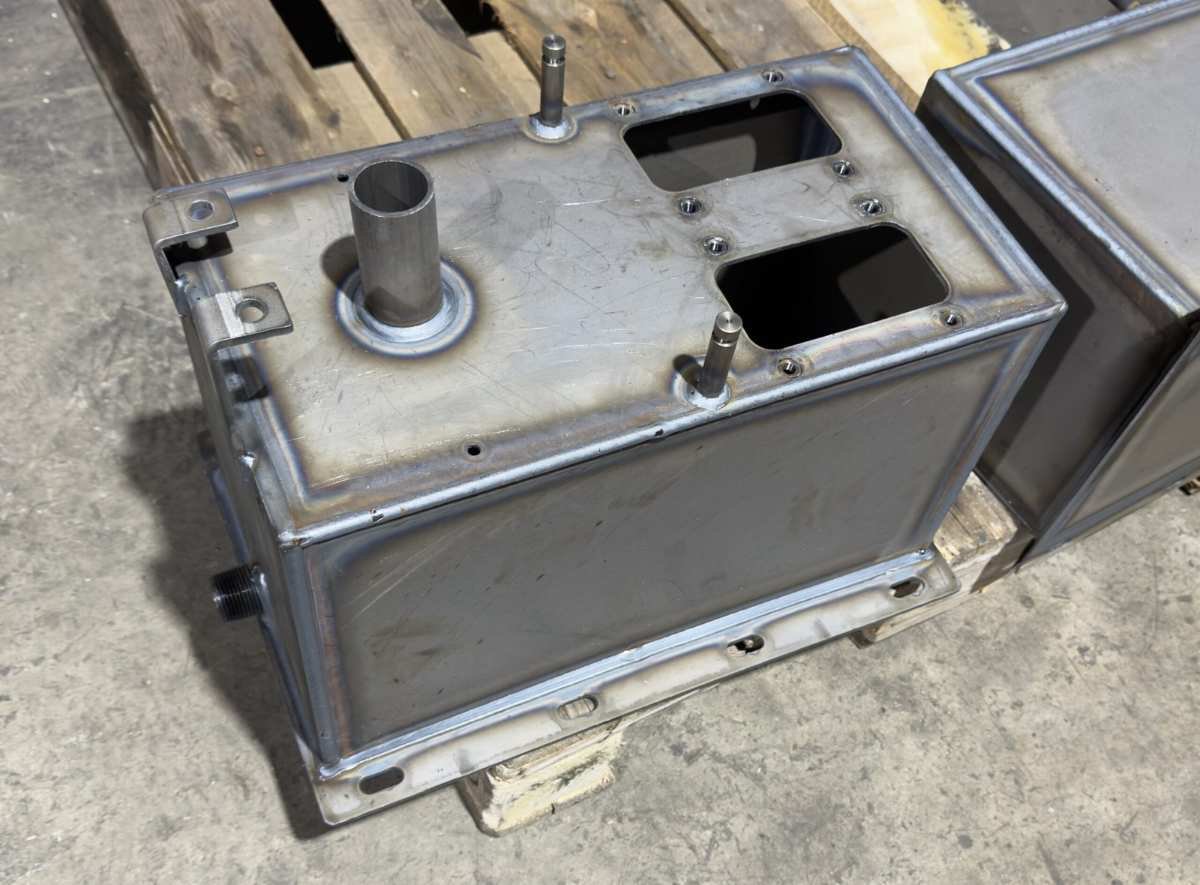
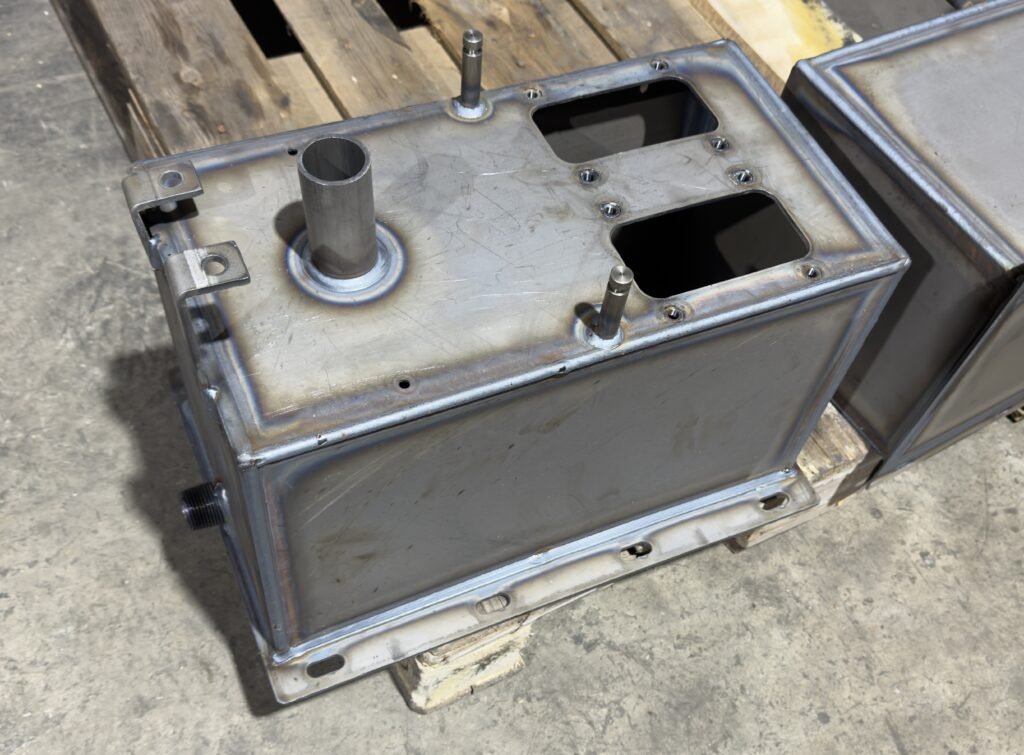
Multi-Port Reservoir, Machined Top Plate
A production reservoir built around a hydraulic power unit package, with return, suction, and gauge ports positioned to spec.
Industries We Serve
See more on our Industries Served page.
Frequently Asked Questions
What does a hydraulic reservoir tank do?
It stores hydraulic fluid and conditions it before it returns to the pump — dissipating heat, releasing entrained air, letting contaminants settle, and supplying clean fluid to the pump suction line.
How does a hydraulic reservoir tank work?
Fluid returns through the return port, crosses internal baffles that slow and separate it from the suction side, radiates heat into the tank walls, releases air through the breather, and lets contaminants settle before clean fluid is drawn back to the pump.
How do I size a hydraulic reservoir?
Hydraulic reservoir capacity depends on pump flow, duty cycle, heat generation, fluid volume changes, available cooling, and operating conditions. Flow-based sizing rules can provide an initial estimate, but final tank capacity should be verified for the specific hydraulic system. See our hydraulic reservoir sizing guide for more information.
What material is best for a hydraulic reservoir tank?
Carbon steel for most industrial and OEM applications, stainless steel for food-grade, marine, or chemical environments, and aluminum where weight is a priority.
Should I choose carbon steel, stainless steel, or aluminum?
It depends on your environment and weight requirements — carbon steel for general use, stainless for corrosive or washdown conditions, aluminum for mobile or weight-sensitive equipment.
Why are internal baffles used in hydraulic reservoir tanks?
Internal baffles help control returning hydraulic fluid, reduce turbulence, limit direct flow from the return port to the pump suction, and support air separation. Baffle quantity, size, and placement depend on reservoir geometry, flow rate, and operating conditions. Not every hydraulic reservoir requires the same baffle arrangement.
Can you manufacture a hydraulic reservoir tank from my CAD drawing?
Yes. Engineered Welding manufactures custom hydraulic reservoir tanks from customer drawings and specifications, including STEP, DXF, SolidWorks, and PDF files. Our team reviews material, dimensions, wall thickness, port locations, mounting requirements, and fabrication details before production. We support prototypes and repeat OEM manufacturing orders.
What file formats do you accept for custom tank quotes?
STEP, DXF, SolidWorks, and PDF. A physical sample or dimensioned sketch also works if you don’t have a formal CAD file.
What ports should I include?
At minimum a suction port, return port, drain, and filler breather. Many tanks also add a sight gauge, clean-out cover, magnetic drain, and temperature gauge port.
Do you pressure test every tank?
Yes. Every tank is leak tested and inspected before it ships, with documented results available on request.
Can you manufacture prototypes?
Yes, from single prototype units through full production runs, using the same process each time.
Do you powder coat the tanks?
Yes, powder coating is done in-house and available alongside wet paint for complex geometries or specific color matching.
What’s the difference between powder coating and paint for hydraulic tanks?
Powder coating cures to a thicker, more chip- and corrosion-resistant finish. Wet paint offers more flexibility for color matching and complex shapes.
What industries use hydraulic reservoirs?
Agriculture, construction, industrial manufacturing, hydraulic power units, forestry, truck equipment, waste equipment, mining, material handling, and OEM equipment.
What’s the difference between a vertical and horizontal reservoir?
Vertical tanks have a smaller footprint for tight floor space; horizontal tanks offer more fluid surface area for heat dissipation and air separation, and suit mobile equipment with height restrictions.
Can a hydraulic tank be too big?
Yes — oversizing adds unnecessary weight, cost, and footprint without improving performance. Size to actual heat load and duty cycle.
What is a sight gauge used for?
It lets you visually check fluid level (and, on combination units, temperature) without opening the tank.
How long does it take to get a custom hydraulic reservoir tank?
Domestic fabricators with stable capacity typically run 3 to 6 week lead times, though this varies with complexity and volume. Contact us with your drawing for a specific timeline.
Do you ship nationwide?
Yes — we ship from Anamosa, Iowa to OEM customers across the United States, for prototype and production orders alike.
What’s the difference between a hydraulic reservoir tank and a hydraulic power unit?
The reservoir is the fluid storage and conditioning component. A hydraulic power unit is the full assembly — pump, motor, valves, controls — built around it.
Should I spec a heavier gauge tank for longer service life?
Often yes. Many OEMs now spec 3/16″ or 1/4″ plate over lighter gauges to hold up better under vibration and extend service life.
What quality documentation is available for custom hydraulic reservoir tanks?
Engineered Welding performs leak testing and final inspection on custom hydraulic reservoir tanks. Depending on customer requirements, available documentation may include material certifications supplied by vendors, leak-test records, dimensional inspection results, and final inspection photographs. Documentation requirements should be specified during the quotation process.
Why Choose Engineered Welding?
We’ve been manufacturing in Anamosa, Iowa since 2002, and we’ve built and shipped over 80,000 hydraulic reservoirs with zero defects — a track record that comes from controlling the entire process in-house rather than outsourcing steps to third parties.
Every tank starts as your CAD file or drawing, not a modified stock design. From there it moves through HD plasma cutting and CNC press brake forming on our own equipment, robotic and manual welding from AWS D1.1-trained welders, 100% leak testing, and in-house powder coating — all under one roof, whether you need one prototype or an ongoing production run shipped nationwide.
See our full capabilities on Fabrication Services, browse example builds in our project gallery, or read more about our shop on the About Us page.
Need a Custom Hydraulic Reservoir Tank?
Engineered Welding manufactures custom hydraulic reservoir tanks for OEM equipment builders across the United States. Whether you need a single prototype or ongoing production, our team can build to your exact specifications.