If you’ve been searching for plasma cutting services in Dubuque and coming up with a mix of vague promises and unclear pricing, you’re not alone. Metal fabricators, contractors, and manufacturers across the Tri-State area need a cutting partner who can deliver clean edges, tight tolerances, and parts that show up on time — without blowing the budget.
That’s exactly what plasma cutting services in Dubuque are built to solve. Whether you’re sourcing structural steel components, custom brackets, or precision stainless parts for a hydraulic tank build, plasma cutting gives you a fast, accurate, and cost-effective way to turn raw metal into finished parts.
In this guide, we’ll walk through how CNC plasma cutting works, why it’s become the go-to process for custom metal cutting, what precision cutting services actually involve, and where stainless steel plasma cutting fits into industrial and commercial projects. By the end, you’ll know exactly what to look for in plasma cutting services in Dubuque — and why quality, speed, and affordability shouldn’t be a trade-off.
Why Quality, Speed, and Affordability Matter Together
Here’s the thing: most shops can offer you one or two of these. Fast and cheap often means rough edges and rework. High quality without speed means missed deadlines. The shops worth working with treat all three as non-negotiable, not a menu you pick from.
A quality-first plasma cutting operation cuts down on secondary finishing work, which saves you money even if the per-part price looks slightly higher upfront. Fast turnaround keeps your project on schedule instead of waiting weeks for a supplier. And affordability — real affordability, not just a low quote with hidden costs — comes from a shop that’s invested in the right equipment and doesn’t waste material or time.
Plasma Cutting Technology
Understanding CNC Plasma Cutting
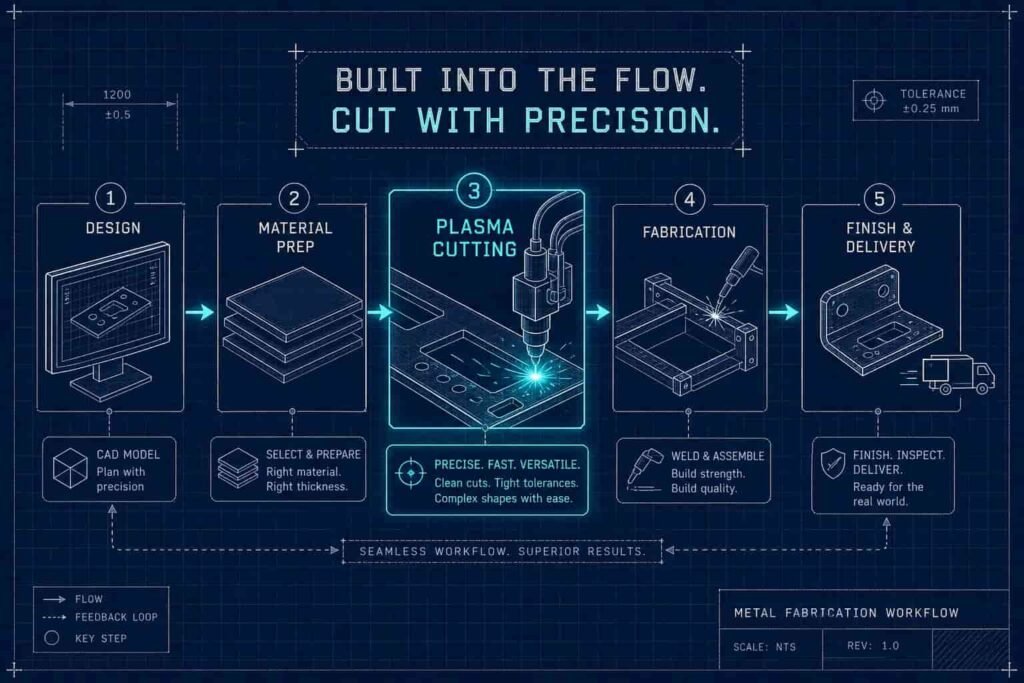
CNC plasma cutting uses a computer-controlled torch that sends a high-velocity jet of ionized gas (plasma) through the metal, melting it along a precisely programmed path. Because the cutting head is guided by CAD/CAM software rather than a human hand, every part comes out consistent — the tenth piece matches the first one exactly.
The process works on any electrically conductive metal: mild steel, stainless steel, aluminum, and copper alike. That versatility is a big reason CNC plasma cutting has become the workhorse of metal fabrication shops, especially for jobs that mix material types across a single project.
Benefits of CNC Plasma Cutting
A few reasons fabricators keep coming back to CNC plasma cutting:
- Speed — plasma systems can cut at well over 300 inches per minute on thinner materials, meaning faster turnaround on production runs.
- Cost efficiency — compared to laser cutting, plasma tables typically have lower equipment and operating costs, savings that get passed along on your quote.
- Thick-material performance — plasma handles thick plate (up to several inches) far more efficiently than laser or waterjet in many cases.
- Reduced waste — nesting software optimizes how parts are laid out on a sheet, so less material ends up as scrap.
- Minimal secondary work — high-definition plasma systems produce cleaner edges and squarer cuts, cutting down on grinding and finishing time.
Applications of CNC Plasma Cutting
CNC plasma cutting shows up in more places than most people realize. Structural steel fabrication, heavy equipment components, agricultural parts, trailer and truck bodies, HVAC ductwork, and custom brackets are all common jobs. In the hydraulic and tank fabrication world specifically, plasma-cut components form the backbone of reservoirs, mounting plates, and structural supports — exactly the kind of work a Dubuque shop serving industrial clients handles daily.
Custom Metal Cutting Solutions
No two fabrication projects are identical, which is why custom metal cutting matters as much as the cutting process itself.
Customization Options
A good plasma cutting partner doesn’t just run your file through a machine — they work with you on part geometry, hole placement, bevel angles, and nesting to get the most efficient (and most accurate) result. That might mean adjusting kerf width for tight-tolerance holes or recommending a different cut order to reduce heat distortion.
Material Choices
Custom metal cutting means working across material types and thicknesses: mild steel, stainless steel, aluminum, and more, from light-gauge sheet up to heavy plate. The right shop will tell you upfront which material and thickness combination makes sense for your application, rather than just cutting whatever you specify.
Design Specifications
Every custom job starts with a design file — typically a DXF or DWG drawing — and clear specifications on tolerances, edge finish, and hole sizing. Tighter tolerances and finer edge quality take more programming and process control, so it’s worth being specific about what your application actually requires versus what “looks nice on paper.”
Examples of Custom Projects
Think about the range of parts that come through a plasma table in a given month: structural gussets for a construction contractor, custom brackets for an agricultural equipment manufacturer, mounting plates for industrial machinery, and precision panels for a hydraulic reservoir. Custom metal cutting is what lets a single shop serve all of those industries without retooling for each one.
Precision Cutting Services
The Importance of Precision in Metal Cutting
Precision isn’t just a nice-to-have — it’s what determines whether your parts bolt together correctly the first time. A hole that’s off by a fraction of an inch, or an edge with excess dross, can mean rework, wasted material, and a delayed project. Precision cutting services reduce that risk by controlling every variable in the cut: amperage, travel speed, gas selection, and torch height.
Tools and Equipment Used
Precision starts with the right hardware. High-definition plasma systems, downdraft cutting tables, and CAD/CAM nesting software all work together to hold tight tolerances consistently. Regular maintenance on consumables — electrodes, nozzles, and shields — matters just as much as the equipment itself, since worn parts are one of the most common causes of inconsistent cuts.
Plasma Cutting Equipment Overview
The plasma cutting equipment a shop invests in directly affects the quality you receive. High-definition plasma cutters produce a narrower kerf, squarer edges, and less taper than standard plasma systems, which means fewer parts need secondary grinding or machining before they’re ready to use.
Technological Advancements in Plasma Cutting
Plasma cutting technology has come a long way from the rough, wide-kerf cuts of older systems. Modern high-definition plasma delivers edge quality that rivals laser cutting on many materials, at a fraction of the operating cost. Newer torch and consumable designs also extend part life between changeovers, and software-driven process control adjusts cutting parameters in real time to hold consistency across a full sheet. For fabrication shops, that means faster cycle times and fewer rejected parts — savings that show up directly in your quote.
Stainless Steel Plasma Cutting
Benefits of Using Plasma for Stainless Steel
Stainless steel plasma cutting requires more process control than mild steel — gas selection, amperage, and travel speed all need to be dialed in to avoid heat discoloration and warping. Done right, plasma cutting produces stainless parts with a clean, bright edge and minimal dross, without the longer cycle times you’d see from other cutting methods on thicker stainless plate.
A shop experienced in stainless steel plasma cutting knows to manage heat input carefully — spacing cuts appropriately and controlling travel speed — since stainless retains heat more than mild steel and is more prone to warping if that’s ignored.
Industries That Require Stainless Steel Cutting
Stainless steel plasma cutting is essential in industries where corrosion resistance and hygiene matter: food and beverage processing equipment, chemical storage and hydraulic tanks, commercial kitchen fabrication, and marine or wastewater applications. Any application exposed to moisture, chemicals, or repeated washdowns typically calls for stainless.
Case Studies of Successful Projects
Picture a hydraulic reservoir manufacturer needing stainless steel baffles and mounting plates cut to tight tolerances for a corrosive-environment application. Or an agricultural equipment builder needing stainless brackets that can withstand years of outdoor exposure without rusting. In both cases, the difference between a usable part and a returned one comes down to a shop that understands stainless steel’s quirks — not just one that owns a plasma table.
Why Local Plasma Cutting Services in Dubuque Make a Difference
Sourcing plasma cutting services in Dubuque instead of shipping parts in from out of state comes with real advantages beyond convenience. A local shop can turn around a rush order in days instead of weeks, walk your drawings through in person if there’s a question about tolerances, and adjust a nest mid-run if your project scope shifts.
Dubuque’s position in the Tri-State area — bordering Illinois and Wisconsin — also means a local plasma cutting provider is already set up to serve the region’s heavy manufacturing, agricultural equipment, and industrial tank and reservoir builders. That regional focus is part of what separates a true metal cutting solutions partner from a shop that just runs your file and ships a box.
Frequently Asked Questions
What materials can plasma cutting services in Dubuque cut?
Plasma cutting works on any electrically conductive metal, including mild steel, stainless steel, aluminum, and copper, in thicknesses ranging from thin sheet to heavy plate.
How does CNC plasma cutting differ from manual plasma cutting?
CNC plasma cutting is guided by a computer program and CAD/CAM software, which means every cut is precise and repeatable. Manual plasma cutting depends on an operator’s hand, so tolerances and consistency vary more from part to part.
How much does plasma cutting service cost?
Pricing depends on material type and thickness, part complexity, cut length, and order volume — most shops quote per part or per hour of machine time rather than a flat rate. Simple parts in thin material cost far less than thick-plate work with tight tolerances or heavy nesting. The most accurate way to get a number is to send your drawings and quantities for a quote.
Which is better, laser cutting or plasma cutting?
It depends on the job. Laser cutting generally wins on thin material where razor-sharp edges and the tightest tolerances matter most. Plasma cutting wins on thicker plate, where it cuts faster and at a lower cost per part, making it the more practical choice for structural and heavy-fabrication work.
What is a disadvantage of plasma cutting?
Plasma cutting produces a wider kerf and more heat-affected zone than laser cutting, so it’s typically less precise on thin material and can leave dross that needs secondary grinding. A shop that maintains its consumables and dials in amperage, gas, and travel speed correctly minimizes these issues.
Is a plasma cutter worth owning, or is it better to outsource?
For occasional or one-off cutting needs, outsourcing to a dedicated plasma cutting shop is usually more cost-effective than buying, maintaining, and operating your own machine. Owning a plasma cutter tends to pay off only when cutting volume is high and consistent enough to justify the equipment, consumables, and skilled labor it requires.
How thick of steel will a plasma cutter cut?
It depends on the machine. Handheld plasma cutters typically handle up to about 1 to 1.5 inches of steel, while industrial CNC plasma systems with higher amperage can cut plate several inches thick — though cut speed and edge quality drop off as thickness increases.
What should you not cut with a plasma cutter?
Plasma cutting only works on electrically conductive materials, so it can’t cut wood, plastic, glass, rubber, or ceramics. It’s also not the best choice for very thin sheet metal where heat distortion is a concern, or for applications requiring a laser-level edge finish with no heat-affected zone.
Will a plasma cutter cut through painted metal?
Yes, plasma cutters can cut through painted, coated, or rusted metal. That said, coatings tend to produce more smoke and fumes and can slightly affect edge quality, so clean, bare metal generally gives the best results.
What size air compressor is recommended for a plasma cutter?
As a rule of thumb, your compressor should deliver about 1.5 times the CFM your plasma cutter draws. Cutting thin material (up to roughly 3/8″) typically needs around 4–5 CFM at 60–90 PSI, while cutting thicker plate (1–2″) can require 10–15 CFM at 75–90 PSI. Production plasma tables often run on dedicated shop air systems rather than a single portable compressor.
Will a 20 or 30 gallon air compressor run a plasma cutter?
A 20- or 30-gallon compressor can run a smaller handheld plasma cutter for light, intermittent cutting on thin metal, but tank recovery time limits how long you can cut continuously. For production work or thicker material, a larger compressor or dedicated shop air supply is a better fit.
Do you hook up an air compressor to a plasma cutter?
Yes — most plasma cutters run on compressed air (or, for some processes, nitrogen or oxygen) delivered through an air line, typically with a filter, regulator, and dryer inline. Clean, dry, properly pressurized air is essential, since moisture and debris in the line can damage consumables and cause poor cut quality.
Is a plasma cutter as bright as a welder?
Yes — the plasma arc produces intense light, including UV radiation, that’s comparable to a welding arc in brightness. Proper eye protection with an appropriately shaded lens (similar to welding shade levels) and skin protection are essential any time you’re operating or standing near a plasma cutter.
What is the average lifespan of a plasma cutter?
It varies by machine quality, duty cycle, and how well it’s maintained. Industrial CNC plasma systems can run for many years with proper consumable replacement and maintenance, while lighter hobbyist units generally have a shorter service life under heavy use.
Can plasma cutting hold tight tolerances?
Yes, especially with high-definition plasma systems. While it may not match laser cutting’s precision on very thin material, modern plasma cutting equipment holds tolerances tight enough for the vast majority of structural and fabrication applications.
How long does a typical plasma cutting project take?
Turnaround depends on part complexity, material thickness, and order volume, but CNC plasma cutting’s speed — often exceeding 300 inches per minute on thinner materials — means most Dubuque shops can turn around standard jobs quickly.
Get a Quote on Plasma Cutting Services in Dubuque
Whether you need a one-off custom part or ongoing production runs, the right plasma cutting partner should deliver quality, speed, and affordability without asking you to compromise on any of them. If you’re ready to get your project cut right the first time, reach out to discuss your drawings, materials, and timeline. Browse our blog for more fabrication tips and project insights.