
How to Spec a Custom Hydraulic Reservoir Tank
Specifying a custom hydraulic reservoir tank looks simple on paper — it’s a steel box that holds oil, right? In practice, the reservoir does far more than store fluid: it dissipates heat, settles contamination, releases entrained air, and anchors your whole hydraulic power unit. Get the spec wrong and you’ll fight overheating, aeration, and premature pump wear for the life of the machine.
Before you write the spec, our hydraulic reservoir tank guide covers the fundamentals: how a reservoir works, sizing, materials, and standard features.
We’ve manufactured more than 80,000 hydraulic reservoirs with zero defects at our shop in Anamosa, Iowa, so we’ve seen what a good spec looks like — and what happens when one detail gets skipped. Here’s how to spec your tank right the first time.
Start With Capacity — but Don’t Stop There
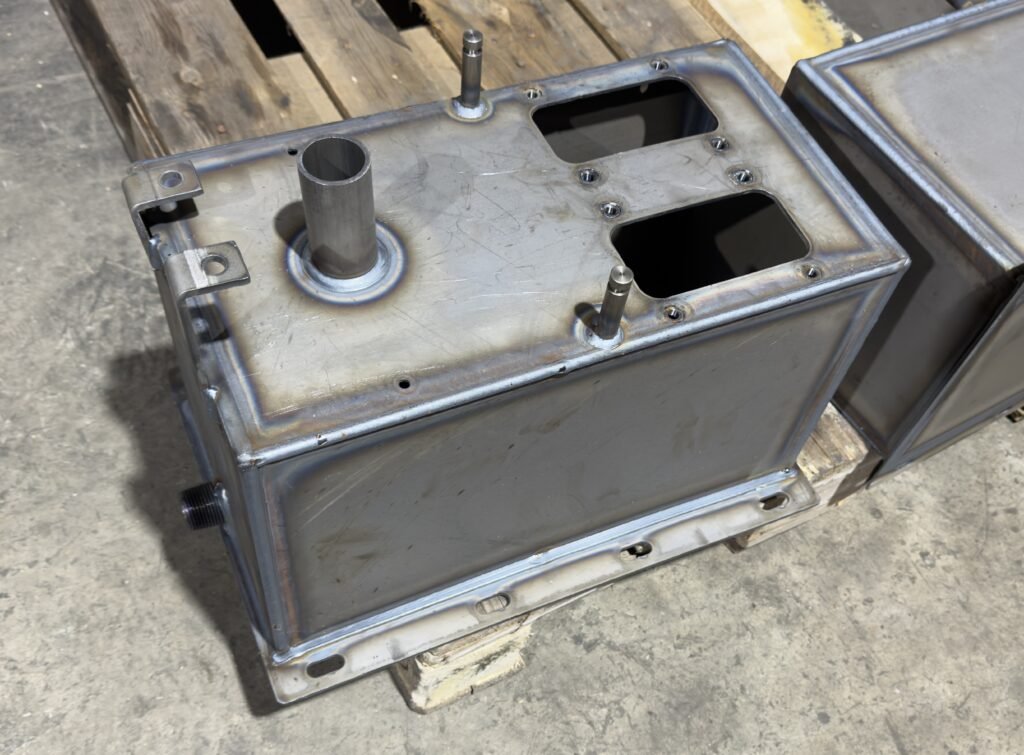
The old rule of thumb says reservoir volume should be two to three times your pump’s flow rate in gallons per minute. A 20 GPM system would get a 40–60 gallon tank. That’s a starting point, not an answer. Mobile equipment often runs smaller reservoirs to save weight and space, which puts more pressure on cooling and de-aeration design. Industrial power units can afford the full ratio and benefit from it.
The real questions: how hard does the system cycle, how hot does it run, and how much room do you actually have? Your fabricator should be able to work through those trade-offs with you — that’s part of what you’re paying for.
Steel vs Stainless Steel for Your Hydraulic Tank
Carbon steel is the default for most custom hydraulic reservoir tank builds — it’s strong, economical, welds beautifully, and takes powder coat well. Choose stainless steel when the environment demands it: washdown areas, food and beverage plants, marine and coastal equipment, corrosive chemical exposure, or anywhere the tank exterior can’t be protected by paint alone.
The honest answer is that most systems don’t need stainless — but the ones that do, really do. If you’re unsure, describe the operating environment to your fabricator and let them weigh in before you pay the stainless premium.
What Is the Purpose of Baffles in a Hydraulic Reservoir Tank?
Baffles are internal plates that force returning oil to take the long way around before the pump picks it up again. That slow trip does three jobs at once: it gives entrained air time to rise and escape, lets contamination settle to the bottom, and moves heat to the tank walls where it can dissipate. A properly baffled tank also stops fluid from sloshing straight from the return line to the suction line — a shortcut that sends hot, aerated oil right back into your pump.
Typical practice separates the return side from the suction side with a baffle about two-thirds the height of the fluid level. Complex tanks may use multiple baffles or diffusers. If a quote comes back without baffles on anything but the smallest tank, ask why.
Hydraulic Reservoir Ports Design
Port design is where custom tanks earn their keep. Think through:
- Suction port — sized generously and positioned well above the tank floor so it never picks up settled contamination, but below minimum fluid level so it never sucks air.
- Return port — on the opposite side of the baffle from suction, ideally discharging below fluid level to prevent foaming.
- Fill/breather — a filtered breather cap sized for the tank’s air exchange; undersized breathers cause pressure swings.
- Drain — at the true low point, so maintenance can actually get all the old fluid and sludge out.
- Sight gauge and temperature ports — cheap to include now, painful to retrofit later.
- Cleanout access — a bolted cleanout cover lets you inspect and clean the tank interior over its service life.
SAE straight-thread O-ring ports are standard for leak-free connections; specify sizes and locations on your drawing, or provide the mating components and let the fabricator detail it.
Mounting, Accessories, and Finish
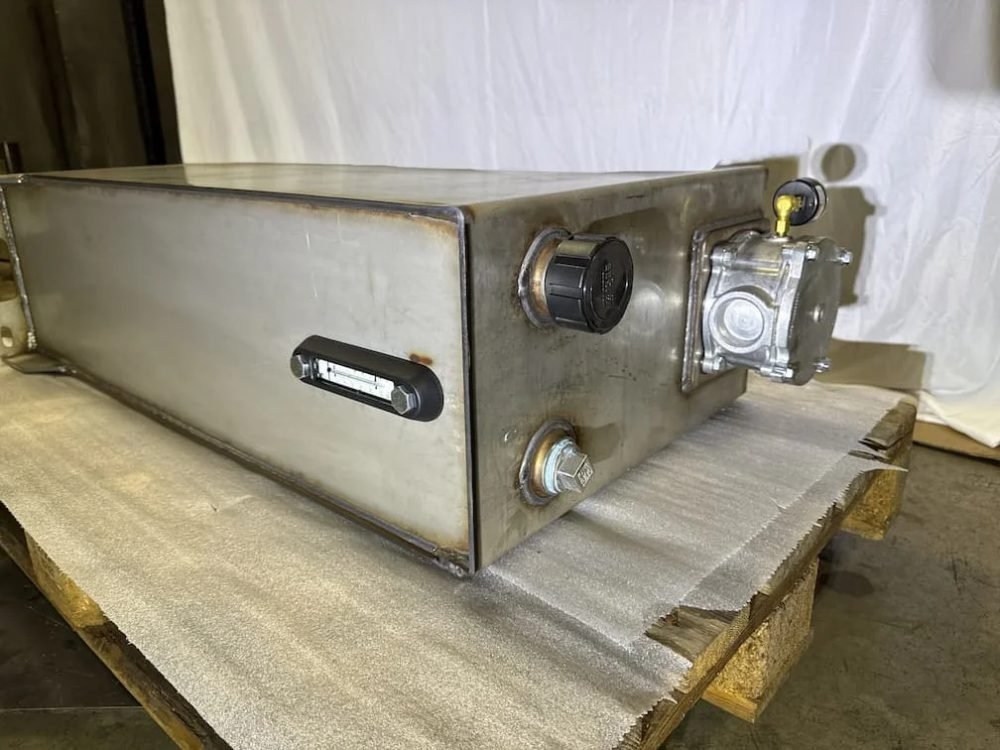
Spec your mounting style up front — feet, brackets, saddle mounts, or direct integration into a frame — because it affects the weld sequence and reinforcement. The same goes for accessories: filler/breather assemblies, filtration heads, level switches, and heat exchanger provisions are all easier to build in than bolt on. For finish, powder coating over properly prepped steel is the durable standard; interior surfaces should be cleaned and sealed to keep the fluid clean from day one.
Leak Testing: Non-Negotiable
Every hydraulic tank should be leak-tested before it ships — no exceptions. Our process pressure-tests every reservoir, which is a big part of how 80,000+ tanks have gone out the door with zero defects. Ask any fabricator you’re considering how they test, and what happens if a tank fails.
Frequently Asked Questions
A hydraulic reservoir does more than store fluid. It dissipates heat from the system, gives entrained air time to escape, lets contaminants settle out before fluid returns to the pump, and provides expansion room as cylinders extend and retract. That’s why internal design — baffles, port placement, and return-line routing — matters as much as raw capacity.
Carbon steel is the standard for most industrial reservoirs — strong, weldable, and economical. Stainless steel is the choice where corrosion resistance matters: washdown environments, outdoor mobile equipment, marine, or food-grade applications. Engineered Welding builds custom reservoirs in both carbon and stainless steel to your specification.
Work through it in order: capacity first (based on pump flow and duty cycle), then material for your operating environment, then internal design — baffles, port sizes and locations, and return-line configuration — and finally mounting style, accessories, and finish. This guide walks through each of those decisions, and a fabricator worth working with will review your spec before cutting steel.
The core set: a filler/breather cap, a fluid level and temperature sight gauge, a suction strainer, a return-line diffuser, a drain port, and clean-out access covers. Depending on the environment, add a desiccant breather for humid conditions, level or temperature switches for monitoring, and ports for a heat exchanger if the duty cycle runs hot.
Capacity, envelope dimensions, material, port sizes and locations, baffle requirements, mounting style, accessories, and finish. A drawing is ideal, but a sketch with dimensions plus a description of the system gets a quote started.
Sheet or plate is cut (we use plasma cutting), formed on a press brake, welded — in our case with AWS D1.1 certified MIG welding, robotic or manual — then fitted with ports and accessories, leak-tested, and finished.
Both. We build one-off custom hydraulic reservoir tanks and full production runs; repeat designs move to robotic welding for consistency.
Ready to Spec Your Tank?
Send your drawing, sketch, or even a photo of the tank you’re replacing to contact@engineeredwelding.com or call 319-462-4840. Learn more about our custom hydraulic tank manufacturing, or see finished tanks in our gallery. We serve customers across eastern Iowa, including Cedar Rapids and Dubuque.